The History of Yankee Stadium: From a Bronx Lumberyard to the Cathedral of Baseball
The story of Yankee Stadium is the story of one of the most famous sports venues on earth. Located in the Bronx, New York, it has hosted more than a century of baseball, popes, boxers, rock legends, and even football championships. In this article we cover why the team is called the Yankees, how and why the stadium was built in the Bronx, its capacity across the decades, its most unforgettable home runs, and the museum that preserves its legacy today.
Why Are They Called the Yankees?
Before getting to the stadium, it's worth understanding where the team's name comes from. The franchise began in 1901 as the Baltimore Orioles and moved to New York in 1903, adopting the name Highlanders. That name came largely from the fact that their first ballpark, Hilltop Park, sat on high ground in upper Manhattan, and from the Scottish heritage of team president Joseph Gordon, whose surname evoked the Gordon Highlanders, a famous Scottish military unit.
The practical problem was that "Highlanders" was long and awkward for newspaper headlines. According to historian Marty Appel, a New York sportswriter grew tired of that limitation and simply started calling the team "the Yanks," a name that fit headlines far better. The nickname caught on starting in 1904, and in 1913 it was officially adopted as the New York Yankees, coinciding with the team's move to the Polo Grounds.
Building the First Yankee Stadium
During their first decade in New York, the Yankees had no home of their own; they shared the Polo Grounds with the New York Giants, the city's dominant team. That changed because of one player: Babe Ruth.
Owner Jacob Ruppert wanted a stadium of his own that reflected the team's growing stature, so in 1920 he partnered with Colonel Tillinghast Huston to search for land. Sites in Manhattan's West Side (above the train tracks) and Long Island City, Queens, were also considered.
Why was Yankee Stadium built in the Bronx?
The choice of the Bronx came down to a mix of strategy and opportunity. The chosen site was a 10-acre lumberyard directly across the Harlem River from the Polo Grounds, within walking distance of Coogan's Bluff. Ruppert and Huston bought it from William Waldorf Astor for $675,000, close enough to Manhattan to keep their fan base, but far enough to have their own land and stop depending on the Giants, who in fact pushed them out of the Polo Grounds after the 1922 season.
Construction officially began on May 5, 1922, after Mayor John Francis Hylan closed the surrounding streets to make way, and was completed in just 284 days. The walls were built with an especially durable concrete developed by Thomas Edison. The total cost was around $2.5 million, paid entirely by Ruppert.
The stadium opened on April 18, 1923, against the Boston Red Sox, with a storybook ending: Babe Ruth hit a home run in his first at-bat at his new home, in front of nearly 60,000 fans. That's why it's still known as "The House That Ruth Built," though it also earned the nickname "The Marble Palace" for its elegant facade.
Yankee Stadium's Capacity Through History
The original stadium was a pioneer: horseshoe-shaped, built with three tiers, and the first ballpark ever officially called a "stadium" because of its enormous size, with capacity for 58,000 fans at its opening.
Over the decades, capacity shifted significantly with each renovation. It opened at 58,000 in 1923, peaked at a historic 82,000 in 1927, sat at 71,700 in 1937, dropped to 54,000 following the major 1976 renovation, and stood at 56,900 before its final closing in 2008.
A curious footnote: the record attendance for a baseball game at the stadium was 85,265 spectators in 1928, more than 20,000 above the official capacity of the time.
More Than Baseball: The Old Stadium's Great Events
Yankee Stadium was never just a baseball field. Ruppert designed it with other spectacles in mind, and over time it became one of the most versatile venues in the country.
Boxing: the first bout took place just four months after the stadium opened, in July 1923, in front of 58,000 spectators. Over the years the stadium hosted legendary title fights, including the historic Joe Louis-Max Schmeling rematch in 1938.
Football: it hosted the Army vs. Notre Dame college classic starting in the 1920s and was home to the NFL's New York Giants from 1956 to 1973. It also hosted the legendary 1958 NFL Championship between the Giants and the Baltimore Colts, known as "the greatest game ever played."
Concerts: performers included Frank Sinatra in the classic era, and later, at the new stadium, names like Jay-Z, Eminem, Paul McCartney, Metallica, Madonna, Justin Timberlake, Garth Brooks, Bad Bunny, and the Jonas Brothers.
Papal visits: the stadium hosted three historic Catholic masses: Pope Paul VI in 1965, John Paul II in 1979, and Benedict XVI in 2008, at the old stadium shortly before it closed.
Other curious records: the largest crowd the stadium ever drew wasn't for a game at all, but for a Jehovah's Witnesses convention in 1950, with 123,707 people in attendance.
Unforgettable moments: on July 4, 1939, Lou Gehrig delivered his emotional farewell speech ("Today, I consider myself the luckiest man on the face of the earth"), one of the most remembered moments in American sports history.
Yankee Stadium's Most Important Home Runs, and What Those Balls Are Worth
No stadium has witnessed as many historic home runs as Yankee Stadium. Some of the most remembered:
Babe Ruth (April 18, 1923): the first home run in the stadium's history, in the very inaugural game, forever branding the venue "The House That Ruth Built."
Lou Gehrig (1932): became the first player in World Series history to hit four home runs in a single game.
Mickey Mantle (May 31, 1956): his shot off Cuban pitcher Pedro Ramos nearly became the first ball to leave Yankee Stadium entirely, missing the roof facade by inches.
Roger Maris (October 1, 1961): his 61st home run broke the record Babe Ruth had held since 1927, a mark that stood in the American League for 61 years.
Reggie Jackson (October 18, 1977): hit three home runs off three different pitches in Game 6 of the World Series, earning the nickname "Mr. October."
Aaron Judge (2022): although his record-breaking 62nd home run, which finally surpassed Maris's mark, was hit on the road in Texas, the entire chase toward the record played out most intensely in front of the Bronx crowd.
How much is a historic Yankees ball actually worth?
The sports memorabilia market has turned some of these baseballs into genuine fortunes. Aaron Judge's 62nd home run ball from 2022 sold at auction for $1.5 million, the second most expensive baseball ever sold. Mark McGwire's 70th home run ball from 1998, the record-holding home run ball of its era, sold for $3.05 million, still the highest price ever paid for a baseball. Barry Bonds's 756th career home run ball, the all-time career record, sold for $752,467. A Babe Ruth home run ball from 1933 is estimated by experts at between $500,000 and $1 million, depending on provenance and condition.
For scale: in 2022, auction house SCP Auctions estimated that Judge's 60th home run ball, tying Babe Ruth's mark, was already worth between $100,000 and $150,000, and that the historic 62nd could reach a million dollars before it was even hit. The final price ended up higher still.
The Major Renovation and the Move to a New Stadium
By the late 1960s, the stadium was showing clear signs of structural decay, with chunks of concrete occasionally coming loose from the stands. New York City bought it in 1972 and, between 1974 and 1975, gave it a full renovation that created the look generations would come to remember (during that time, the team played at Shea Stadium).
The old Yankee Stadium remained standing until September 21, 2008, after 85 years of history and 6,581 regular-season home games.
The New Yankee Stadium (2009)
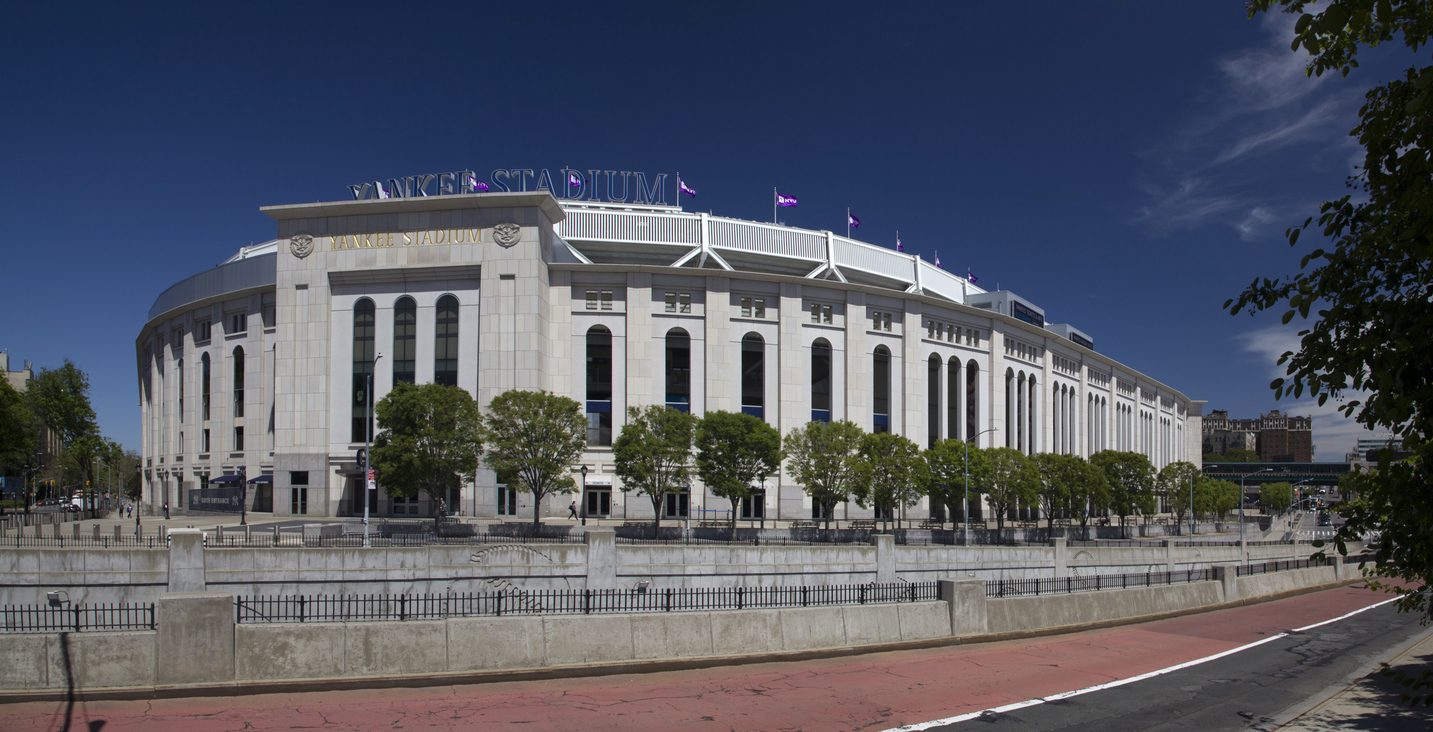
The new Yankee Stadium opened in April 2009, situated on the former grounds of Macombs Dam Park, just one block north of the original site. The design replicates elements of the original, including its exterior facade and signature frieze, while incorporating larger, more modern spaces.
Construction used 11,000 pieces of Indiana limestone, from the same quarry used for the Empire State Building, along with granite and precast concrete. The total cost reached $2.3 billion, making it the most expensive stadium ever built at the time.
Capacity of the new Yankee Stadium
Unlike the original, the new stadium prioritizes comfort over raw seat count. It currently holds 46,537 spectators, considerably fewer than the old stadium, but with more space, better amenities, and 4,300 club seats plus 68 luxury suites.
The new stadium also knows non-baseball spectacle
The tradition of hosting events beyond baseball continued, and even grew. Since 2015, MLS club New York City FC (soccer sibling of Manchester City) plays its home matches there. Manchester City itself visited for friendlies in 2013 (a 5-3 win over Chelsea) and 2014 (a 2-2 draw with Liverpool). The stadium annually hosts the Pinstripe Bowl, a major college football bowl game. In 2014 it hosted two NHL outdoor hockey games among the Rangers, Devils, and Islanders. New York University graduations are also held there.
The Yankee Stadium Museum
Two distinct spaces preserve the team's history within the current stadium, and though they're often confused, they are separate.
Monument Park is an open-air museum located beyond the center field wall. Its history dates back to the original Yankee Stadium in 1932, when the team posthumously dedicated a monument to manager Miller Huggins in center field. Over the years more monuments and plaques were added, and in 1985 the area opened to the public for the first time. Only six people in franchise history have received the highest honor, a monument on a red granite block: manager Miller Huggins, players Lou Gehrig, Babe Ruth, Mickey Mantle, and Joe DiMaggio, and owner George Steinbrenner. When the team moved to the new stadium in 2009, the entire contents of Monument Park, monuments, plaques, and retired numbers, were relocated to a faithful replica of the space.
The New York Yankees Museum, presented by Bank of America, is a separate space located inside the stadium itself. Its centerpiece is the Baseball Wall, flanked by statues of Don Larsen and Yogi Berra, alongside the team's Commissioner's Trophies. The museum opens 90 minutes before the first pitch of every home game and closes at the end of the eighth inning. Among its ongoing goals: collecting a signed ball from every player, coach, manager, and broadcaster in franchise history.
Both spaces can be visited on game day or through the guided tours the team offers throughout the season, including the offseason.
Frequently Asked Questions (FAQs)
Why are the New York Yankees called the Yankees? Although they began as the Highlanders in 1903, sportswriters started calling them "the Yanks" starting in 1904 because it fit headlines better. The name was officially adopted in 1913.
Why was Yankee Stadium built in the Bronx? Because the team needed its own ballpark after years of sharing the Polo Grounds with the Giants, and the Bronx offered a large, accessible site close to Manhattan across the Harlem River.
What is Yankee Stadium's capacity? The original stadium opened with 58,000 seats and reached a peak of 82,000 in 1927. The current stadium, opened in 2009, holds 46,537 spectators.
How much did it cost to build Yankee Stadium? The original cost $2.5 million in 1923. The new stadium, opened in 2009, cost $2.3 billion.
What's the difference between Monument Park and the New York Yankees Museum? Monument Park is an open-air space with monuments and retired numbers honoring team legends. The Museum is a separate, indoor space featuring trophies, signed baseballs, and memorabilia.
A Legacy That's Still Alive
From the lumberyard bought in the Bronx in 1921 to the modern limestone coliseum that stands today, Yankee Stadium has been far more than the home of a baseball team. It has hosted 27 World Series championships, papal visits, championship boxing matches, historic concerts, and some of the most unforgettable moments in American sports. Whether the original, "the Cathedral of Baseball," or its successor, the stadium remains, for millions of fans, a place of pilgrimage.
The Bronx that built Yankee Stadium is the same Bronx behind hip hop, salsa, and some of the richest cultural history in New York City. Real's Tours NYC has been showing visitors this side of the borough since 2011.
👉 Explore NYC Tours — Real's Tours NYC
Related Articles
NYC Contrasts Tour & New York in One Day 2026: The Honest Guide
Is the Bronx and Brooklyn Dangerous? The Truth About NYC Neighborhoods in 2026
Harlem Week 2026: The Complete Guide
Real's Tours NYC is not affiliated with the New York Yankees, Major League Baseball, or the New York Yankees Museum. Historical figures and prices are drawn from public reporting and are subject to revision as new records or sales occur.