How a Small Port Became the Capital of the World
How did a 17th-century trading post become one of the most influential cities on the planet? The history of New York is a story of ambition, diversity and constant reinvention, written by people who arrived from every corner of the world. Knowing it changes the way you see every street in the city.
In this guide we tell you the history of New York, from its first inhabitants to today, and the places where you can still see it.
Last updated: October 29, 2026.
The Lenape and the First Europeans
Long before New York existed, this land was the home of the Lenape, who called the island Mannahatta. In 1524 the explorer Giovanni da Verrazzano became the first European to sail into the harbor, and in 1609 Henry Hudson, sailing for the Dutch, explored the river that now bears his name.
New Amsterdam (1624–1664)
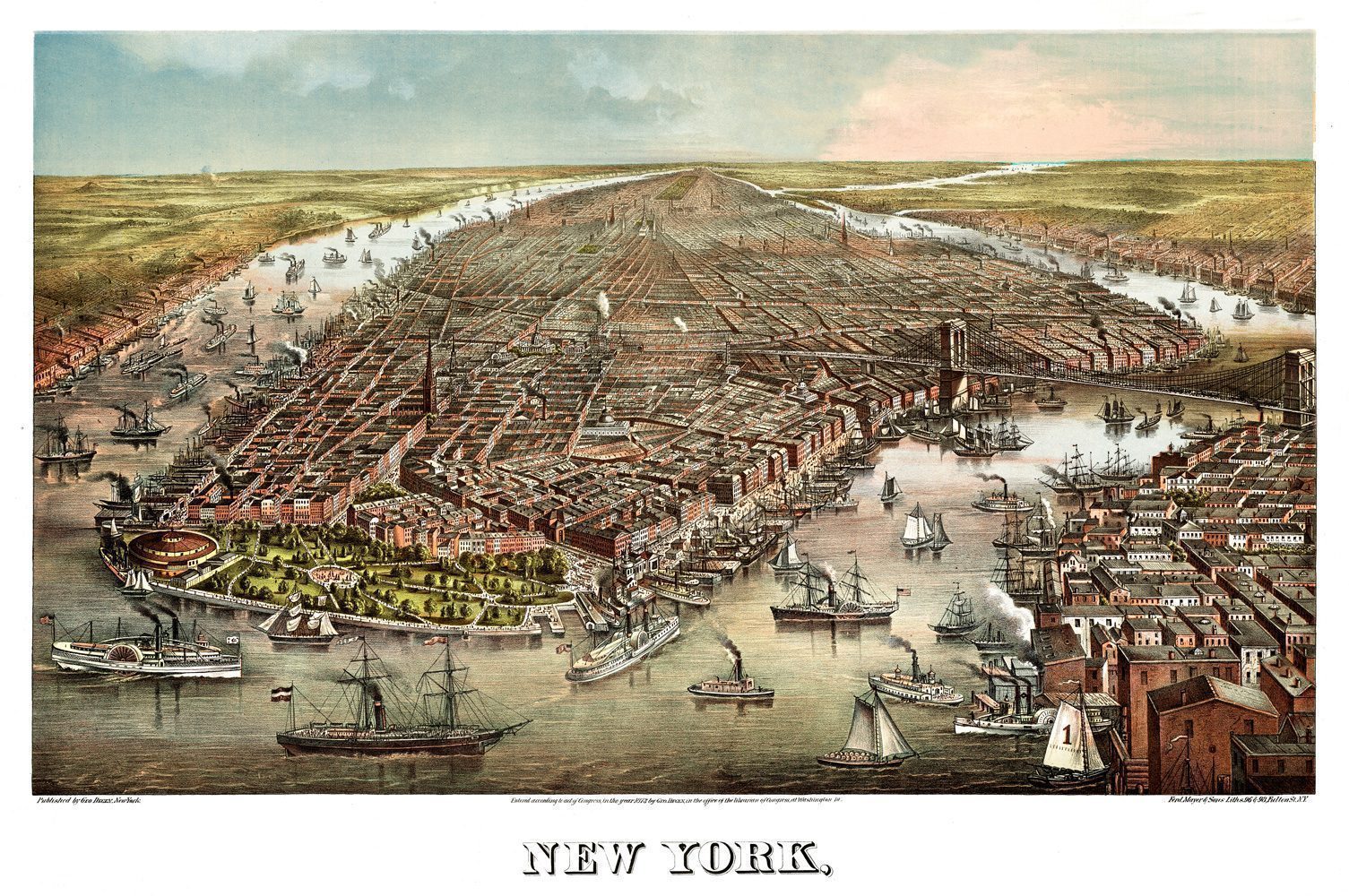
In the 1620s the Dutch founded New Amsterdam at the southern tip of Manhattan, and in 1626 Peter Minuit purchased the island from the Lenape for goods valued at 60 guilders. In 1653 the settlers built a wooden wall to protect the town: that wall gave its name to Wall Street. In 1664 an English fleet took the colony without a fight and renamed it New York, in honor of the Duke of York.
Revolution and the First Capital
During the American Revolution, the British occupied New York from 1776 until 1783. After independence, the city was the capital of the United States between 1785 and 1790, and on April 30, 1789, George Washington took the oath as the first president at Federal Hall, on Wall Street.
The 19th Century: Port, Grid and Immigration
In 1811 the city approved the grid of streets and avenues that would organize Manhattan. The opening of the Erie Canal in 1825 made New York the most important port in the country. In 1858 Central Park began to open, in 1883 the Brooklyn Bridge was inaugurated, in 1886 the Statue of Liberty arrived, and from 1892 millions of immigrants entered through Ellis Island. In 1898 Manhattan, Brooklyn, Queens, the Bronx and Staten Island joined to form Greater New York.
The 20th Century: The Global City
The subway opened in 1904, and in the 1920s and 1930s skyscrapers like the Chrysler Building and the Empire State Building redefined the skyline. The Harlem Renaissance turned the city into a cultural capital, and in 1952 the United Nations headquarters opened in Manhattan, after meeting temporarily in Queens.
The 21st Century: Memory and Rebirth
On September 11, 2001, the attacks on the World Trade Center deeply marked the city. New York rebuilt itself: today the 9/11 Memorial honors the victims, and One World Trade Center, opened in 2014, is the tallest building in the Western Hemisphere.
New York in Dates
| Year | Event |
| 1524 | Verrazzano sails into the harbor |
| 1626 | Peter Minuit purchases Manhattan |
| 1664 | New Amsterdam becomes New York |
| 1789 | Washington is sworn in at Federal Hall |
| 1825 | Opening of the Erie Canal |
| 1883 | Opening of the Brooklyn Bridge |
| 1892 | Ellis Island opens |
| 1898 | The five boroughs join |
| 1931 | Opening of the Empire State Building |
| 2001 | 9/11 attacks |
Where to See This History Today
On our Upper and Lower Manhattan Tour you travel the island from north to south and end in the Financial District, where New Amsterdam and Wall Street began, next to Battery Park. If you also want to see the Bronx, Queens and Brooklyn, choose the NYC Contrasts Tour + Upper and Lower Manhattan, and to visit the island where millions of immigrants arrived, get our Statue of Liberty and Ellis Island tickets.
Frequently Asked Questions
Why is it called New York?
In honor of the Duke of York, brother of the English king, when the English took the Dutch colony in 1664.
Was New York the capital of the United States?
Yes, between 1785 and 1790. George Washington was sworn in at Federal Hall in 1789.
Where does the name Wall Street come from?
From the wooden wall the Dutch built in 1653 to protect New Amsterdam.
When were the five boroughs united?
On January 1, 1898.
Related Articles
The 5 Boroughs of New York: History, What to See and How to Explore Them
Ellis Island: The History of America’s Gateway and How to Visit It W
hen the UN Met in Queens: The Forgotten History Behind the NYC Contrasts Tour
Sources
Sources: Wikipedia, History of New York City, New Amsterdam, Federal Hall, Erie Canal and Consolidation of New York City; National Park Service, Federal Hall National Memorial (nps.gov); Real’s Tours NYC, tour itineraries (realstoursnyc.com).
Real’s Tours NYC is not affiliated with any organization mentioned in this article. Schedules and itineraries may change, so please confirm current details when you book.