
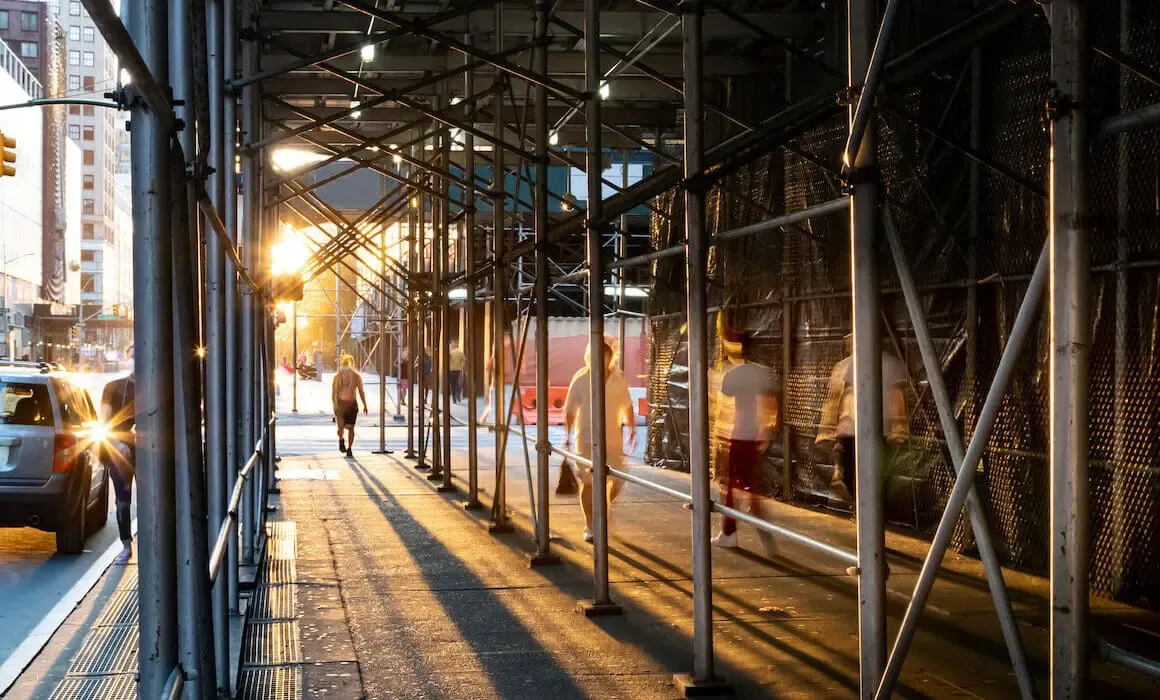
Why are there so many scaffolds in New York? The Reason That Surprises Tourists
If you're visiting New York for the first time, you'll probably notice something curious:there are scaffolding on almost every street in Manhattan.
Many tourists ask:
Are all the buildings under construction?Is it temporary?Why do they seem permanent?
The answer has to do with safety, strict laws, the aging of buildings... and with the history of the city itself.
New York isn't just growing upwards. It also ages.
New York is a Very Old City (Architecturally)
Although Manhattan looks modern because of its glass skyscrapers, much of its buildings were built between the late 19th and early 20th centuries, during the great real estate boom after the Industrial Revolution.
Neighborhoods like the Upper West Side, Harlem, Midtown, and the Financial District are filled with historic buildings built with:
- Limestone
- Terracotta
- Solid brick
- Early Reinforced Concrete
These materials were tough, but with more than 100 years of exposure to extreme winters, acid rain, thermal changes, and traffic vibrations, the facades begin to deteriorate.
And in a vertical city, a small fragment falling from 20 stories can be dangerous.
Here comes the key.
Local Law 11: Mandatory Facade Inspection
The New York City Department of Buildings requires all buildings over six stories to be inspected every five years.
This regulation is known as Local Law 11 or FISP (Façade Inspection Safety Program).
But this law was not born out of modern prevention... He was born by accident.
In 1979, a college student died when she was struck by a fragment of façade that fell from a building in Manhattan. That sparked public outrage and forced the city to create strict regulations.
Since then:
- Every tall building must be inspected by certified engineers.
- Facades are classified as "safe", "safe with repair" or "unsafe".
- If there is a risk, immediate protection should be installed.
And that protection is usually a scaffolding.
Why do scaffolds stay so long?
When a façade needs repair or even just structural evaluation, structures known as sidewalk sheds (the typical green scaffolding) are installed.
But the process is not fast.
Repairs can take months or even years because:
- Getting permits in New York is complex.
- Buildings may need detailed structural studies.
- The restoration of historic stone requires specialists.
- Costs can exceed millions of dollars in large buildings.
In some cases, homeowners prefer to keep the scaffold installed while planning repairs.
That is why many seem permanent.
How many scaffolds are there in New York?
It is estimated that there are more than 8,000 active scaffolding structures in the city at any given time.
Manhattan concentrates the largest amount due to:
- Urban density.
- The average height of buildings.
- The large number of century-old buildings.
In fact, some urban studies have calculated that scaffolding covers hundreds of linear kilometers of sidewalks.
Are they all for Reparations?
Not always.
Some are placed as a preventative measure when an engineer classifies the façade as "safe with repair."
That means there is no immediate danger yet, but there is potential future risk.
For many homeowners, maintaining scaffolding can be more economical than facing hefty fines or lawsuits for falling materials.
Fun fact: the color green is not accidental
Most scaffolding in New York is green because city regulations set that color as the standard for temporary safety structures.
The specific shade facilitates night-time visibility and urban uniformity.
Over time, green became part of the landscape. For some street photographers, it even represents the "real aesthetic" of Manhattan.
Do they affect tourism?
Although they sometimes block historic facades or make perfect photos difficult, they are part of the authentic character of the city.
New York is not a frozen museum.
It is a living city that constantly:
- It is repaired
- It is renewed
- Transforms
Scaffolding is the visible reflection of this permanent maintenance.
So... Are they temporary?
Yes... but in New York "temporary" can mean several years.
It is not that the city is deteriorated.It is one of the cities with the strictest structural regulations in the world.
In other cities, a crack may go unnoticed. In New York, it must be inspected and documented.
🗽 Conclusion
If you see scaffolding everywhere in Manhattan, it's no coincidence.
It is the result of:
- Historic buildings over 100 years old
- Safety regulations created after real accidents
- Mandatory maintenance every five years
- And a city that never stops updating itself
The next time you walk under one, you'll know it's not carelessness... it is prevention.
Frequently Asked Questions (FAQs)
- Are sidewalk sheds safe? Absolutely. They are engineered to shield pedestrians from any potential debris.
- Why are the scaffolds always green? "Hunter Green" is the city’s official color for these structures to ensure urban uniformity.


